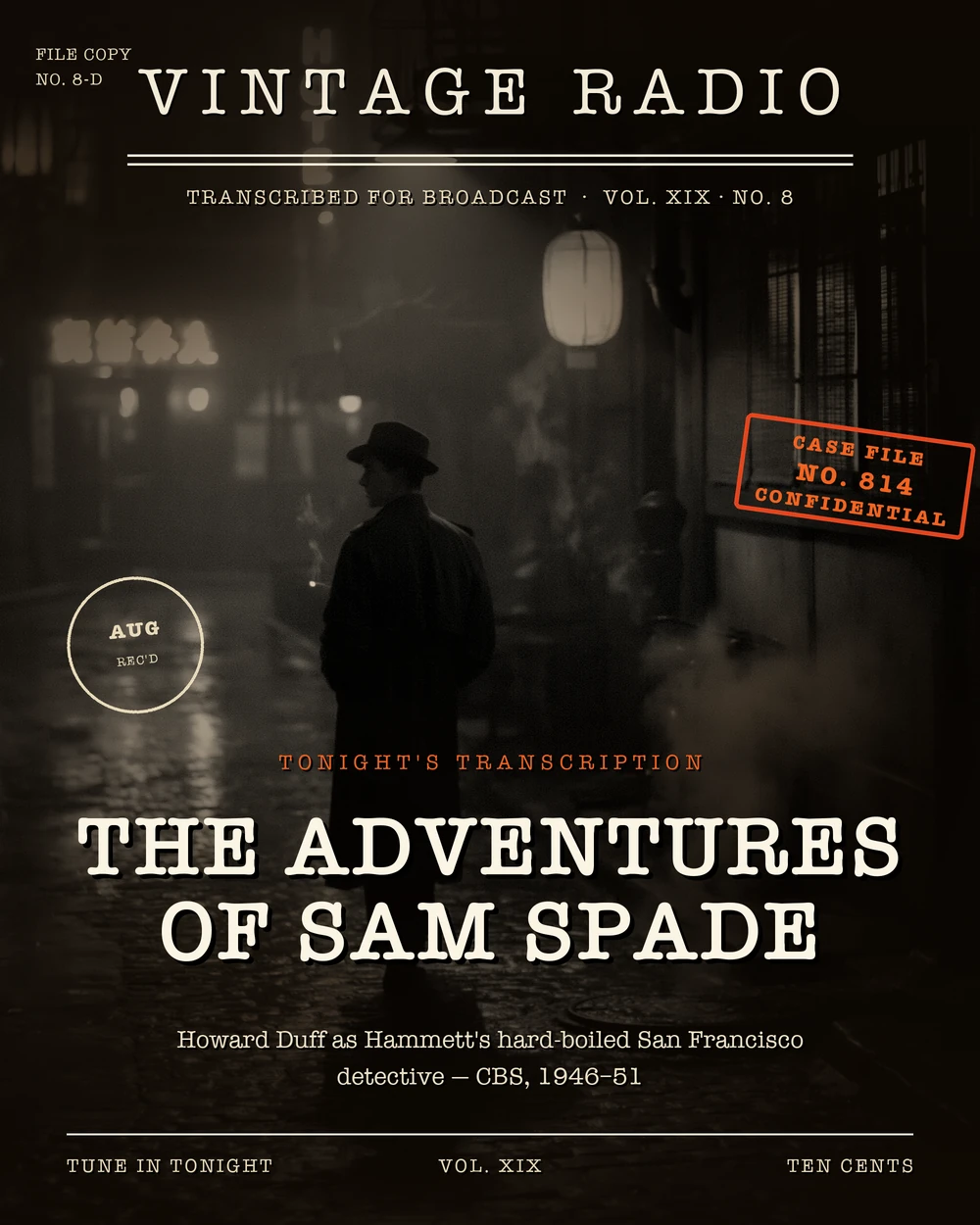
The Adventures of Sam Spade
The Show That Owned the Private Eye Format
The Adventures of Sam Spade ran on three networks over five years and produced 245 broadcast episodes, but what made it stand apart from every other Crime-Detective program on the air wasn't the case plots or the San Francisco atmosphere — it was tone. Where most private eye radio played it hard and humorless, Sam Spade went for something subtler: a detective who was tough and street-smart but also funny, a little vain, and fond of cheap booze. The show didn't parody the genre; it just found the humanity — and the comedy — in it without softening the edges.
The character came from Dashiell Hammett's 1930 novel The Maltese Falcon, and Hammett's name appeared in the credits throughout the run, lending the series a literary credibility that most radio detective shows couldn't claim. In practice, Hammett had no direct involvement beyond the name and the royalty checks. The scripts were the work of a small team of professional radio writers, and the world they built borrowed Hammett's San Francisco, his license number (137596), and the bones of his characters — then ran with them in their own direction.
Producer-director William Spier shaped every corner of the program's sound. Spier had run CBS's Suspense from 1942 through early 1948, and a 1949 magazine piece described him as "generally rated radio's top-notch creator of suspense-type dramas." He brought that structural discipline to Sam Spade while allowing the show a playfulness Suspense rarely permitted. The opening device — Spade dictating a case report to his secretary Effie, dated with the actual air date — became one of the more distinctive narrative formats in radio drama.
How It Got on the Air
The series launched on ABC on July 12, 1946, with Wildroot Cream Oil as sponsor, but the groundwork had been laid months earlier. An audition record was cut on May 1, 1946, using a script titled "Sam and the Walls of Jericho," adapted by writers Bob Tallman and Jo Eisinger. According to radio historian John Scheinfeld, ABC was eager to give the impression that Hammett was genuinely involved with the production, even though he was not — the literary name added prestige. During the 13-episode ABC run, Tallman and Eisinger received no on-air credit; the scripts were simply presented as being "based on" Hammett's work. The duo was first credited when the show moved to CBS on September 29, 1946, where it would run for three years under the same Wildroot sponsorship.
Before Spier cast his lead, he reportedly considered Lloyd Nolan and Elliott Lewis for the role of Spade. What he wanted, specifically, was an actor in the Humphrey Bogart mold. Howard Duff didn't immediately seem to be it. Duff had come to Hollywood in 1945 after earning his radio experience with the Armed Forces Radio Service, and his initial reading for Spier was, by most accounts, less than memorable. It was Spier's wife at the time, singer-actress Kay Thompson, who was struck by something in Duff's audition and pushed hard for him to get the part. Thirteen weeks into the run, the gamble had paid off completely.
The character of Sam Spade had already appeared on radio twice before the series began — Edward G. Robinson played him in a 1943 Lux Radio Theater production of The Maltese Falcon, and Humphrey Bogart reprised the film role in a 1946 Academy Award Theater production. Duff's version would become the definitive one.
The Sound of the Series
Every episode opened the same way: Spade dictating a case file to Effie Perrine, his secretary. The dictation framed the whole story — scenes from the case dramatized as Spade described them, before pulling back to the office where Effie waited, slightly flustered, to type up the report. It was a clean device that let the show cut between first-person narration and full dramatic scenes without awkwardness, and it gave Duff enormous room to editorialize in character.
Lurene Tuttle played Effie as perpetually breathless, perpetually behind, and secretly in love with her boss. The dynamic between Spade and Effie carried much of the show's warmth — his greetings to her ("Me, sweetheart") and farewells ("Goodnight, sweetheart") were recurring motifs that tied directly to the closing theme, "Goodnight, Sweetheart." Jerry Hausner played Sam's lawyer, Sid Weiss, a recurring presence in Spade's caseload. Sound man Berne Surrey's weekly contribution included the sound of clinking glasses each time Spade opened his desk drawer — a detail that landed the same way every episode and never got old.
Spade's preferred mode of transport was the streetcar, a dime a ride. He had an aversion to cabs and a weakness for cheap booze. Episode titles followed a consistent "caper" format — "The Dead Duck Caper," "The Dry Martini Caper," "The Femme Fatale Caper" — which itself became part of the show's texture. The early scripts depicted a somewhat darker Spade: according to Martin Grams Jr., who reviewed all surviving scripts, early installments included Spade stealing money from a dead man's wallet and other morally ambiguous acts. Over time, the writing shifted toward humor and a more open romantic dynamic between Sam and Effie.
Tallman and Eisinger — Eisinger writing under the pseudonym Jason James due to a Columbia Pictures contract — wrote the scripts through mid-1947, when Gil Doud took over as Tallman's co-writer. The two wrote every episode from March 1947 through June 19, 1949, when they stepped away, "written-out and going insane." A rotating group that included John Michael Hayes, E. Jack Neuman, and Harold Swanton handled the final stretch. The original Tallman-Eisinger team won the Edgar Award for Best Radio Drama from the Mystery Writers of America in 1947.
William Spier and the Production Behind the Show
William Spier was born October 16, 1906, in New York City. He started in radio in 1929 at the agency Batten, Barton, Durstine and Osborn, where he produced the Atwater Kent Hour and several General Motors programs. He directed and co-wrote The March of Time in 1936, where he gave Orson Welles his first radio job. His years running Suspense at CBS made him one of the most technically accomplished producer-directors in the business before he brought those skills to Sam Spade.
The show's support cast was drawn from the Hollywood radio pool — Cathy Lewis, Elliott Lewis, June Havoc, Joseph Kearns, Elliott Reid, Mary Jane Croft, Jeanette Nolan, and Betty Lou Gerson appeared across the run. John McIntire played Lieutenant Dundy in the original series; William Conrad stepped into the role for the NBC run. Music was handled by Lud Gluskin and by Rene and Pierre Garriguenc. Dick Joy announced.
One of the more notable production choices came on January 10, 1948, when Spier aired a special one-hour episode titled "The Khandi Tooth Caper" on Suspense — technically a cross-promotion, but also a direct sequel to The Maltese Falcon, reintroducing Gutman, Cairo, and a new gunsel. Actor Robert Montgomery, who had played Philip Marlowe in the film The Lady in the Lake, made a cameo appearance as Marlowe. The Thrilling Detective Web Site has called it "the only real sequel to Dashiell Hammett's The Maltese Falcon" produced in any medium. The episode later aired in two parts on the Sam Spade series itself.
The Red Channels Years and the End of the Run
The show's political troubles arrived by degrees. As early as 1947, the scripts had taken veiled digs at Communist-hunting lawmakers — one episode referenced Representative J. Parnell Thomas by name. Then Dashiell Hammett's name came before the House Committee on Un-American Activities. In June 1950, Howard Duff was listed in Red Channels; his offense was attending a 1948 Hollywood dinner for Progressive Party presidential candidate Henry Wallace, whose campaign had received a Communist Party endorsement. Duff was not himself a Communist, but the listing was enough.
Variety reported that Wildroot would continue sponsorship only if Hammett's name was removed from the credits. The sponsor was also unenthusiastic about continuing with Duff as the lead. In September 1950, Billboard announced that Wildroot was dropping the series entirely and moving its money to a new show called Charlie Wild, Private Detective. The announcement drew approximately 250,000 letters of protest from listeners. NBC continued the series anyway — without Duff, a decision that proved unwise.
Howard Duff's final broadcast was "The Femme Fatale Caper," which aired September 17, 1950. On the premiere episode of Charlie Wild, Private Detective a week later, Duff made a guest appearance in character as Sam Spade, welcoming Charlie Wild to the private investigation business. According to Scheinfeld, those were the last words Duff spoke on radio for six years. His career didn't recover fully until 1957, when he and Ida Lupino — whom he had met on a film set and married in October 1951 — starred together in the CBS sitcom Mr. Adams and Eve.
Steve Dunne took over as Spade on November 17, 1950, when the unsponsored NBC revival launched. Dunne, described as boyish-sounding, had worked as an announcer and newscaster before starring in the radio detective programs Danger, Doctor Danfield and Deadline Mystery. The revival ran through April 27, 1951, and then ended. In 1961, Broadcasting magazine reported that Four Star Productions had completed a television pilot with Peter Falk in the title role; no series resulted.
What Survived, and What Didn't
Of the 245 total broadcast episodes — 13 on ABC, 157 on CBS, and 75 on NBC — approximately 60 to 70 survive in recorded form, the rest lost because the networks didn't routinely record broadcasts. The surviving recordings are there because individual collectors preserved wire recordings and transcription discs. Martin Grams Jr. published The Radio Adventures of Sam Spade in 2007, a 270-page reference covering the full history of the program, biographies of the principal figures, and a complete episode guide for every broadcast. Grams also edited The "Lost" Sam Spade Radio Scripts, published in 2009, reprinting thirteen unrecorded scripts.
The show also generated a newspaper comic strip adaptation depicting likenesses of Duff and Tuttle, a spin-off attempt called Sara's Private Capers in 1950, and serious interest from Universal Pictures in a feature film with Duff in the lead. None of those extended the run, but they measured the size of the audience's investment in the character Duff had built. The word from those who've studied the full archive is consistent: no other radio private eye series matched what this one did at its best.